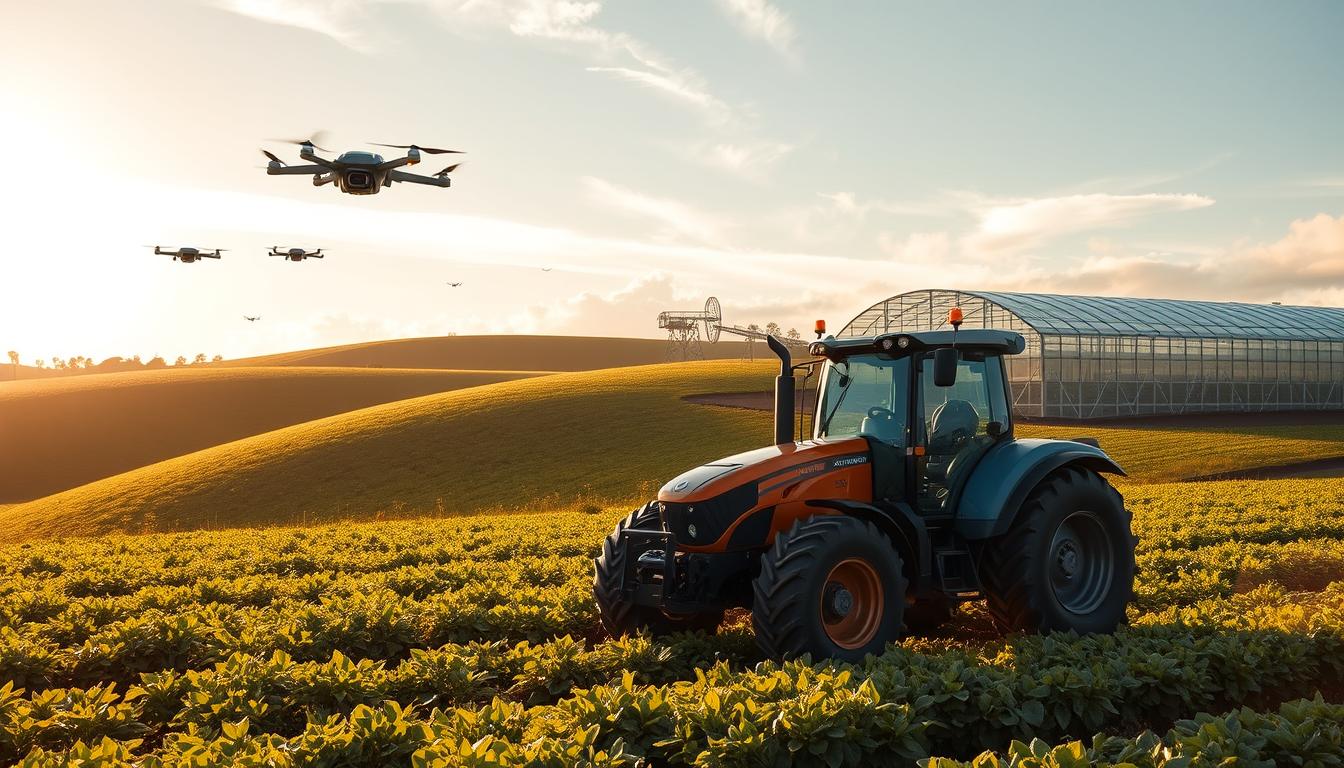
Over 135 autonomous robots are now working on more than 6 million acres of Australian farmland. This big change comes from Queensland’s work in new farming tech. Family-owned farms in Queensland are leading the way in this field.
Queensland-based SwarmFarm Robotics was started by Andrew and Jocie Bate near Emerald. They show how local areas can lead in new tech. Their robots have cut down chemical use by 80% and improved crops.
The Queensland Government is really backing this change. They’ve put over $160 million into research and development for 2024-25. This money helps set up places like Smart Farms at Emerald, Gatton, and Redlands for testing new farming tech.
Queensland wants to make its farming industry worth $30 billion by 2030. This goal shows how new farming tech is making farming better and more sustainable. Farmers, researchers, and tech people are working together to make new things happen.
Key Takeaways
- Queensland leads Australia in agricultural robotics with over 135 autonomous machines deployed across 6 million acres of farmland
- SwarmFarm Robotics achieved 80% reduction in chemical usage through precise robotic application technology
- The Queensland Government invested $160 million in agricultural research and development for 2024-25
- Smart Farms at Emerald, Gatton, and Redlands provide essential testing infrastructure for emerging farm technologies
- Regional farming communities are becoming global leaders in agtech innovation through collaborative development
- Queensland aims to boost primary industries output to $30 billion by 2030 through technology adoption
Notable Global Success Stories in Robotic Farming
Robotic farming has shown success worldwide. It shows how automation can work in different places. This is good for Australian farms too.
These stories help us see how autonomous agricultural robots work in different places. We learn from Japanese rice farmers, Dutch greenhouse workers, American grain farmers, and Australian innovators.
Learning from these stories helps us choose the right technology for our farms. The lessons from overseas are very useful for Queensland and Australia.
Japan’s Smart Rice Cultivation Projects
Japan has led in automated rice farming. They use new tech while keeping traditional farming ways. This shows how robots can help, not replace, old methods.
Japanese farmers use robots to plant rice seedlings perfectly. These machines save a lot of hard work. They make sure the rice grows well.
Systems with sensors watch over the rice all season. They check the water, soil, and health of the plants. This means farmers don’t have to check the fields all the time.
Robots also help harvest the rice. They move through tight spaces and separate the grain from the stalk carefully. This helps Japan’s aging farmers keep up quality.
Robots in rice farming show that new tech and old ways can work together. This way, farming can stay strong for the future.
The Netherlands’ Greenhouse Robotics
The Netherlands is great at using robots in greenhouses. This is good for Australian horticulture too. They show how to use robots in controlled environments.
In Dutch greenhouses, robots pick crops like tomatoes and cucumbers with great care. They use computers to find the ripe ones. This way, the crops don’t get damaged.

Robots in greenhouses also find diseases early. They scan the plants for problems. This means farmers can fix issues before they get worse.
The Netherlands also uses robots to control the climate in greenhouses. They use data to make sure the plants grow well. This shows how robots can help with growing crops indoors.
Places like Queensland’s Gatton Smart Farm use these ideas. They adapt them for Australian farms, especially for growing crops indoors.
U.S. Autonomous Tractor Implementations
America has big tractors that work without drivers. They are perfect for big farms. This is similar to what Australian farmers face.
These tractors follow paths with GPS. They work all day, every day, when it’s safe. They do things like plowing, planting, and harvesting.
These tractors help with big challenges in American and Australian farming. They deal with a lack of workers, huge areas, and short seasons.
The tractors stop if they see something unexpected. This keeps people and animals safe. It also makes farming more efficient.
These tractors can be controlled from one place. This is important for managing big farms. It helps farmers keep everything running smoothly.
Australia’s Drone-Driven Crop Monitoring Systems
Australia is known for its drone monitoring systems. Australian agtech innovations are special for our big and varied farms. These drones help farmers manage their land better.
SwarmFarm Robotics is a big success story from Australia. It started on a farm in Queensland and became a global leader. It helps with the big distances, changing weather, and lack of workers in Australian farming.
Australia’s drones give detailed pictures of crops. They show problems that are hard to see from the ground. This helps farmers fix issues early.
The Queensland Smart Farms network is key for testing these drones. Places like the Central Queensland Smart Cropping Centre help farmers see how these systems work. They make sure they fit Australian needs.
The Gatton Smart Farm tests australian agtech solutions for different types of farming. This helps farmers make smart choices. It reduces the risk of trying new things.
The Redlands Research Facility gives important data for growing crops. This data helps farmers meet quality and safety standards. It’s important for selling crops at home and abroad.
The AgTech Showcase at Gatton Smart Farm was a big success. It showed how learning from technology can help farmers. It won an award for its impact.
After this success, Australian farmers went to the United States to learn more. They saw how autonomous farming works. This helps Australia stay at the forefront of farming technology.
| Region | Primary Focus | Key Technology | Australian Relevance |
|---|---|---|---|
| Japan | Rice Cultivation | Automated transplanting and harvesting robots | Precision techniques applicable to intensive cropping systems |
| Netherlands | Greenhouse Operations | Vision-guided harvesting and disease detection | Direct applications for protected horticulture expansion |
| United States | Broadacre Mechanisation | GPS-guided autonomous tractors | Solutions for extensive grain and cotton operations |
| Australia | Diverse Crop Monitoring | Drone systems and autonomous platforms | Purpose-built for Australian distances and conditions |
Robotic farming is not just one thing. It’s a mix of many technologies. You can find the right ones for your farm.
Learning from others helps Australian farmers. They test new ideas at places like Queensland Smart Farms. This makes sure the tech works for Australian farms.
Stories from around the world show that robotic farming works. It helps farmers in many places. Australian farmers can use these ideas too, with help from local innovations like SwarmFarm.
By using tech from around the world and testing it locally, farmers can make smart choices. They get the best of both worlds. This makes farming better and safer for everyone.
How Robotics Transformed Traditional Agriculture
Your farm’s future depends on using robotics. It changes how you farm, using data and smart tech. This shift is more than just new tools. It changes how you manage crops and make decisions.
Australian farms have changed a lot with robotics. It’s not just about making things work faster. It’s about making farming better, using data and caring for the environment.

Replacing Manual Labour with Autonomous Machinery
Labour has been a big problem in Australian farming for years. Agricultural automation systems solve this with machines that work on their own.
SwarmFarm’s robots are a great example. They do tasks like spraying and seeding without needing people to watch them. Their CEO, Andrew Bate, talks about their approach:
Old farming tools are getting bigger and more complicated. But we think smaller, smarter machines are better. They work together to make farming better, without harming the soil or environment.
This is a big change from using big machines. Smaller robots can work better and longer. They can even do things in bad weather, without getting tired.
When machines do the hard work, you can focus on important decisions. You can improve quality and grow your business, not just work hard.
Precision Farming Through Data and AI
Digital farming changes how you make decisions. Machines can see weeds and crops, so you only use chemicals where needed.
Artificial intelligence looks at lots of things at once. It considers weather, soil, and plant health. This helps make better decisions than humans can.
Every part of your farm gets special care. Robots adjust to what’s happening right then. This means you use less and do better.
DA Hall & Co used robots for egg production. They get data 24/7. This helps keep birds healthy and productive in ways people can’t.
You get to see how your farm is doing like never before. You can make changes based on real data, not just guesses.
Sustainability Gains Through Robotics
Robots are good for the planet and your wallet. SwarmFarm’s tech uses up to 80% less chemicals. This saves money and helps the environment.
Robots are lighter, so they don’t hurt the soil as much. This keeps the soil healthy and saves money on repairs.
The benefits go beyond just saving money:
- Less fuel: Smaller machines use less diesel
- Soil protection: Lighter robots don’t compact the soil
- Water savings: Targeted watering cuts down on waste
- Lower emissions: Better operations mean less pollution
- Better crops: Precise care means more food per acre
Robots help you be green and save money at the same time. It’s rare to find something that’s so good for both the planet and your wallet.
| Transformation Aspect | Traditional Method | Robotic System | Improvement |
|---|---|---|---|
| Chemical Application | Blanket spraying across entire fields | Individual plant-level targeting | Up to 80% reduction in usage |
| Soil Impact | Heavy machinery causing compaction | Lighter robots preserving structure | Maintained soil biology and health |
| Decision Making | Experience-based judgement calls | Data-driven AI recommendations | Optimised interventions and timing |
| Labour Requirements | Continuous human supervision | Autonomous 24-hour operations | Reduced labour costs and availability issues |
Integration Challenges with Legacy Farming Systems
Robots bring big benefits, but they’re not easy to add to old farms. They need special setup that many farms don’t have.
DA Hall & Co faced problems with internet in remote areas. They worked with the AgTech and Logistics Hub to get the right setup. Without good internet, robots can’t work right.
Your old farm software might not work with new robots. You might need new systems that talk to old ones. This can be hard.
Ian Layden from Queensland’s Department of Primary Industries says it takes teamwork to make it work. Economists, researchers, and tech companies need to work together with farmers.
It’s also hard for people to learn new tech. You might need training to use robots well. It takes time to trust machines to do the job.
Changing how you work is also a challenge. Robots work differently than people. You might need to change how you farm and manage your land.
Getting robots to work right is not just about buying them. It’s about changing how you farm and working with what you have. This takes time, money, and a willingness to change.
Who Are the Leading Innovators in Robotic Farming?
Exploring robotic farming, you find innovators from big companies to small startups. They work together to make farming better. This team includes big names, tech firms, and research groups.
These innovators don’t work alone. They create robotic harvesting solutions with help from farmers and research. This teamwork brings new ideas to life.
Specialised Horticultural Automation
Agrobot has made robots for picking strawberries. These robots use computer vision to find ripe berries. They pick the fruit carefully without bruising it.
This is a big step for crops that need careful picking. The robots can handle uneven ground and fragile fruit like a human.
These solutions are great for farms where picking fruit is expensive. The robots help pick only the best fruit, improving quality.

Sustainable Field Robotics Solutions
Naïo Technologies makes robots for organic farming. Their robots weed fields without using chemicals. They work between rows to remove weeds safely.
These robots can find and remove weeds on their own. They protect the crops. This is good for farmers who don’t use chemicals.
Naïo’s robots help the environment and make farming more efficient. This is more than just making things work better.
Established Manufacturers Embracing Autonomy
John Deere is working on self-driving tractors. They use over a century of experience to make farming equipment smarter.
John Deere has a big network of dealers worldwide. They offer support and training that smaller companies can’t match. Buying from them means you get this help.
John Deere makes self-driving tractors easy to use. They know that farmers need to trust and understand the technology. This makes farming better.
Australian Innovation Leading Global Solutions
SwarmFarm Robotics shows how Australian innovators compete globally. They started on a farm in Gindie and now lead in robotic farming. They focus on what farmers need.
Regional areas can be tech hubs with the right support. This shows that you don’t need big cities for advanced manufacturing.
SwarmFarm’s team of 17 engineers works in regional Queensland. They design and build robots for Australian farms. This shows that great engineering can happen outside big cities.
Advance Queensland helped SwarmFarm with funding. Grants up to $200,000 helped them start. This shows how government support can help new ideas grow.
SwarmFarm shows their tech at events like AgTech 2024. They make complex tech easy to see. This helps farmers understand and use new technology.
Research Institutions Pioneering Agricultural Robotics
University research is key for robotic harvesting solutions. Queensland has places like Smart Farms at Gatton. These places test new tech before it’s used.
These places make sure tech works in real farming. This is important for making sure tech is practical, not just theoretical.
Smart Farms brings together research, development, and farmer feedback. This helps tech get better and farmers try new things. It also trains the next generation of farmers.
Knowing about this ecosystem helps you see how robotic farming works. It’s a team effort. This team includes companies, startups, research, government, and farmers. Together, they make farming better.
Why Robotic Farming Projects Succeed (or Fail)
Robotic farming projects don’t succeed or fail by chance. Specific, measurable factors decide if these technologies add value to your farm. Knowing these key success elements helps you make better investment choices. This way, you can pick the right robotic solutions for your farm.
Four main factors can make a project succeed or fail. Each factor affects the others, leading to success or struggles. Knowing these factors before investing helps you use robotics wisely or avoid costly mistakes.
Access to Capital and Government Programs
Getting financial help during early stages is crucial. SwarmFarm got funding from Advance Queensland in 2018. This support was vital for the company’s growth.
The support from Advance Queensland has been instrumental in helping us bring our vision to life.
This funding helped SwarmFarm move from prototype to production. Now, they have 17 staff and over 135 robots across 6 million acres. Without early funding, even great ideas can fail.
Government support also includes rules for using robots. Shared facilities like Queensland’s Smart Farms network help reduce costs. Having big customers shows confidence in new farm tech, encouraging others to adopt it.
Equipment Dependability and Service Networks
Equipment that works well is essential. Farming can’t afford to stop when equipment fails. SwarmFarm’s success shows they’ve met reliability standards.
Keeping equipment working well needs good support. Quick technical help and spare parts are key. Without these, even the best tech can’t help.
Having the right people or services to fix equipment is crucial. This is harder in remote areas. A robot that can’t be fixed is useless, no matter how advanced it is.
Operator Knowledge and System Understanding
Operators need training to use advanced tech. If they don’t, the tech won’t be used to its full potential. DA Hall & Co’s Matt says understanding what you want from AgTech is key.
To truly understand what AgTech they are truly looking at. To understand the AgTech you need to understand what the actual outputs are, that you’re looking for—whether it be through labour savings, whether it be through big data, or whether it be just through trying to give you a small chunk of data that allows you to make better decisions.
Knowing what you want from tech is crucial. Misunderstanding can lead to disappointment. You need to think about how automation fits into your farm’s bigger picture.
Ian Layden from DPI says teamwork is essential. Economists, researchers, and farmers must work together. This ensures tech is chosen wisely, not just for its specs.
Economic Viability and Crop Characteristics
Market conditions and crop types affect tech success. High-value crops can justify more investment. Crops that grow in a standard way are easier to automate.
Before investing, consider your farm’s specific needs. What works in the Netherlands might not work in Australia. This is because of different economics and farming practices.
Think about these key economic factors before investing:
- Crop value per hectare determines how much technology investment the crop can economically support
- Labour availability and cost influences whether automation generates sufficient savings to justify capital expenditure
- Farm scale affects whether fixed technology costs can be spread across sufficient production area
- Market access determines whether productivity improvements translate into increased revenue or simply lower prices
Projects fail when these factors don’t match up. Not enough money can slow down tech adoption. Equipment that’s not reliable can lose farmer trust quickly.
Operators who don’t understand tech blame it for problems. Even the best tech won’t work if it’s not used right. Ian Layden says teamwork is key to success.
Automation sounds neat, and it is. It’s the transformation that we need in Australian systems, but integration into current processes needs to be achieved by a group of people—economists to assess ROI, researchers, farmers etc.
Working together helps avoid costly mistakes. Assessing funding, reliability, training, and economic viability is crucial. This way, you can make informed decisions about robotic farming.
When Did Robotic Farming Gain Momentum?
Robotic farming didn’t start overnight. It grew over decades, thanks to tech advances and farmer adoption. This journey shows how farming tech changed from ideas to real systems in Queensland farms today.
From simple machines to full automation, farming tech followed big tech trends. But it also faced unique farming challenges. Ian Layden points out that farmers first doubted new tech. But once it proved useful, they quickly adopted it.
Foundations of Agricultural Automation
The 1990s started precision farming with GPS. This let farmers guide tractors better, saving time and resources. Controlled Traffic Farming also came up, helping avoid soil damage.
Ian Layden says this early period is key to understanding today’s tech adoption. Farmers were unsure at first. But as benefits showed up, they started using new tech widely.
This decade laid the groundwork for today’s farming tech. It introduced GPS, variable rate systems, and early sensors. These steps paved the way for today’s robots.
Technology Convergence and Commercial Viability
The 2010s saw a robotics boom thanks to new tech. Affordable computers, better sensors, and machine learning made farming robots possible. This was a big change.
SwarmFarm Robotics got Advance Queensland’s Ignite Ideas funding in 2018. This showed investors and governments believed in robotic farming. They saw it as a future for Queensland farms.
Many techs improved in the 2010s. Machine vision got better, and batteries lasted longer. Cloud computing helped with data.
New startups focused on farming robots. They worked on harvesting, weeding, and monitoring. By the end of the decade, robotic farming was real and available.
Rapid Deployment and Infrastructure Development
After 2020, farming tech adoption sped up. The Queensland Government set up Smart Farms at Emerald, Gatton, and Redlands. These places showed off new farming tech.
The November 2024 AgTech Showcase at Gatton Smart Farm drew 1000 farmers. It showed that farming tech is now mainstream. Farmers are seriously looking at using it.
Now, farming tech works with digital systems. Robots connect with data and cloud services. This makes farming smarter and more efficient.
The pressures on farming from a profitability point of view are well known, and we don’t have time to wait another 10 to 20 years for adoption.
Farming faces big challenges like labour shortages and climate change. This means new tech must be adopted fast. The pace of change is faster than before.
Projections and Investment Commitments
By 2030, robotics will be common in farming. Queensland aims for $30 billion in primary industries output by then. The state will invest more than $160 million in RD&E in 2024-25.
The next decade will see big changes in farming. Autonomous systems will become as common as tractors. They will work together, managed by AI.
Robotic data will help predict yields and detect problems early. Farmers will manage systems, not just machines. They will focus on data and planning, not just doing.
This change is as big as the last century’s mechanisation. It’s happening fast, thanks to tech and the need to be sustainable. By 2030, farming will be very different, with automation leading the way.
| Era | Key Technologies | Adoption Characteristics | Queensland Milestones |
|---|---|---|---|
| 1990s Foundation | GPS guidance, variable rate application, Controlled Traffic Farming | Initial scepticism, gradual acceptance through demonstrated benefits | Precision agriculture adoption across major cropping regions |
| 2010s Boom | Machine vision, autonomous navigation, machine learning, cloud computing | Commercial viability achieved, startup emergence, investor interest | SwarmFarm Robotics receives Ignite Ideas funding (2018) |
| Post-2020 Acceleration | Integrated digital ecosystems, coordinated robotic fleets, real-time analytics | Mainstream evaluation, demonstration facilities, rapid deployment | Smart Farms established at Emerald, Gatton, Redlands; AgTech Showcase attracts 1000 producers (2024) |
| 2030 Outlook | AI-optimised farming systems, predictive agriculture, autonomous standard practice | Universal adoption expected, workforce transformation, system-level optimisation | $30 billion primary industries target, $160M+ annual RD&E investment commitment |
This timeline shows how fast farming tech has advanced. It’s moving fast, driven by tech and the need to be efficient.
Where Are Robotic Farming Projects Thriving?
Knowing where robotic farming projects do well helps you find the best tech for your farm. Agricultural robotics australia and global innovations show different areas have their own needs. This helps us see which tech might work best in Australia.
Robotic farming is big in many places, but Australia is leading in some areas. This is especially true for big farms.
Europe’s Precision Agriculture Belt
Europe is a leader in precision farming, with the Netherlands, Denmark, and Germany leading the way. They use a lot of robots because of high labour costs and strict rules about the environment.
Their focus is on using resources well and being good for the planet. This is something Australia also cares about. The Netherlands has robots in greenhouses that work really well, and Germany uses robots to use less chemicals.
Europe’s small farms need robots that are small and can do many things. These rural technology advances show how robots can help even with small farms. This is useful for Australia’s smaller farms too.
Europe’s government helps farmers use new tech by giving them money and support. This makes it easier for farmers to try new things. Australia is starting to see the value in this too.
North America’s Innovation Hubs
In North America, robotic farming is big in California, Iowa, and Canada. They focus on big robots for big farms. Companies like John Deere are based here.
These farms are perfect for testing big robots. There’s a lot of money going into new farming tech in Silicon Valley and the Midwest. This helps new ideas come out fast.
The FIRA event is a big deal for showing off new farming robots. When Queensland sent 17 farmers to the US for FIRA, they saw the latest in rural technology advances. This was useful for Australia’s farms.
North America has led in using GPS and cameras in robots. This has helped Australia’s tech companies, like SwarmFarm Robotics, make better robots for Australian farms.
Asian Smart Farming Expansion
In Asia, Japan, South Korea, and China are using a lot of robots in farming. They have old farmers and small farms, so they need robots to help. This is similar to Australia’s challenges.
Japan is good at making robots for small farms. They have robots for greenhouses, planting, and picking crops. This is useful for Australia’s farms too.
China is investing a lot in farming robots because of food security and a lack of workers. They have big plans to make farming smarter. This is exciting for the future of farming.
South Korea has robots in greenhouses that grow food all year. This is different from Australia’s outdoor farming. But it shows robots can do a lot in the right place.
Emerging African and Latin American Projects
In Africa and Latin America, robotic farming is still new but growing fast. These places face big challenges like Australia, like big distances and changing weather.
Australia’s tech could be great for these places. Australia’s experience with tough farming could be useful.
But Australia’s own farming tech is also important. SwarmFarm Robotics in Queensland has made over 135 robots for farms. This shows Australia can make tech that works in tough conditions.
Queensland is a key place for farming tech in Australia. They have special farms and lots of money for research. This helps farmers try new things.
Queensland is spending a lot on farming research and development. This is over $160 million in 2024-25. This shows they think farming tech is important for the state’s future.
SwarmFarm Robotics has created jobs in Queensland. This shows you don’t need to be in a big city to make tech. Queensland’s success shows that with the right support, any place can be a leader in tech.
Even big farms like DA Hall & Co are thinking about using robots. They show that you need good internet and tech to use robots well.
The spread of farming robots shows it’s not just about the tech. It’s about the needs of the farm, the skills of the people, and the support they get. Queensland’s success shows that with the right plan, any place can lead in tech.
| Region | Primary Focus | Key Drivers | Relevance to Australia |
|---|---|---|---|
| Europe (Netherlands, Germany, Denmark) | Precision agriculture, greenhouse automation, resource efficiency | High labour costs, environmental regulations, small farms | Environmental compliance methods, intensive horticulture solutions |
| North America (California, Iowa, Canadian prairies) | Large-scale autonomous equipment, broadacre automation | Extensive farms, venture capital, major manufacturers | Autonomous navigation systems, broadacre technology platforms |
| Asia (Japan, South Korea, China) | Protected cropping, small-scale automation, vertical farming | Aging populations, food security, fragmented landholdings | Intensive horticulture techniques, precision cultivation methods |
| Australia (Queensland focus) | Extensive broadacre robotics, dryland farming, remote operation | Labour shortages, vast distances, variable conditions, skilled workforce | Domestic innovation optimized for local conditions and climatic challenges |
Australia’s farming tech could help other places with similar challenges. Places in South America, Africa, and Asia might find Australia’s solutions useful.
The future of agricultural robotics will see more hubs in different places. It’s not just about being close to cities. It’s about having the right support and skills for your farm.
What Technologies Power Robotic Farming Success?
Robotic farming uses four key technologies: machine vision, connectivity, navigation, and strong hardware. These work together to improve farming. They help create systems that can do complex tasks on their own.
Understanding how these technologies work together is key. Each one solves specific problems and helps the system work better.
Artificial Intelligence and Computer Vision Systems
AI and machine vision are big changes for robots. They let robots understand their surroundings and make choices on their own. SwarmFarm’s robots can spray, weed, mow, and seed with great accuracy.
These systems can tell plants from weeds and check how healthy they are. They guide equipment with amazing precision. This is better than humans in many ways.
DA Hall & Co used robots with machine vision to stack eggs. The system can spot damaged eggs and move them. It works fast and well.
AI also does predictive analytics. It forecasts when equipment needs fixing and plans the best routes for robots. Over time, these systems get better at farming.
Machine vision lets robots make quick decisions. Humans can’t do this as well, especially with so many plants.
IoT Sensors and Cloud Data Integration
IoT sensors are key for precision farming. DA Hall & Co uses them to track data in real-time. This lets them make decisions from anywhere.
The Central Queensland Smart Cropping Centre showed how SwarmBot works with data. It uses satellite images and soil profiles for detailed field information.
Soil sensors, weather stations, and cameras all send data to the cloud. There, it’s turned into useful information for managing farms digitally.
Sonya Comiskey from FarmTechConnect talks about connectivity:
Connecting systems on the farm is important. How does the accounting system talk to the yield mapping system?
Getting systems to talk to each other is a big challenge. Your systems need to share data smoothly.
Internet Innovations helped DA Hall & Co with connectivity. Joe Prelc says they use reliable 4G. Good internet is key for robots in rural areas.
GPS and Autonomous Navigation
GPS is crucial for robots to move around on their own. Modern GPS is very accurate. This lets robots follow exact paths and find their way back.
SwarmFarm’s robots can move around without help. They avoid obstacles and work together. This needs advanced sensors.
Navigation uses GPS, lidar, and more. It makes decisions based on what it sees. This is important for changing conditions.
But, GPS alone isn’t enough. Robots need good internet to talk to the cloud and humans. This is hard in areas with poor mobile coverage.
| Navigation Technology | Accuracy Level | Primary Application | Integration Requirement |
|---|---|---|---|
| Standard GPS | 2-5 metres | General field location | Basic receiver |
| RTK GPS | 2-5 centimetres | Precision guidance | Base station or correction service |
| Lidar Systems | 1-10 centimetres | Obstacle detection | Real-time processing |
| Vision-Based Navigation | Variable by system | Row following, plant identification | Machine learning models |
Robotics Hardware and Mechanical Design
The physical part of robots is where tech meets farming. Robots need to handle dust, moisture, and more. They must be tough.
Robots also need to be gentle with crops. They must spray or harvest carefully. This requires smart design and materials.
The Gatton Smart Farm tests new tech and ideas. It shows how different technologies work together. This is key for farming success.
Robots are part of a bigger system. They work with new structures, genetics, and farming methods. The whole system must work well together.
These technologies are more powerful together. Machine vision, IoT, GPS, and strong hardware make farming better. They help with precision and efficiency.
No single tech is enough. Together, they change farming for the better. This is true in Queensland and everywhere else.
Comparing Manual vs. Robotic Farming Projects
The move from old to new farming ways isn’t just about replacing people with machines. It’s about big changes in how we work, spend money, and care for the planet. You need to look at real data to see what each method does well and what it doesn’t.
Choosing to go for automation means knowing how robots do in different areas. The results change based on what you value most and your situation. This helps you decide if robots fit your goals and limits.
Yield and Productivity Metrics Comparison
Robots often get better yields because they work when it’s best. They don’t get tired like people do. This means they do tasks at the right time, improving how much you can grow.
SwarmFarm’s clients grow more crops because of robots’ precise work. They can help crops when needed, not just when people are around. This makes a big difference in how crops grow.
DA Hall & Co also saw better results with robots. They handle eggs better and keep track of bird health all the time. This gives them insights they wouldn’t get otherwise, changing how they manage their farm.
But, robots only work well if set up right. If they don’t, they might not be better than old ways. You need to make sure they work well and have good support.
Cost Efficiency and Return on Investment
Robots cost a lot at first but save money later. You save on labour, use less stuff, and grow better crops. But, figuring out if it’s worth it is tricky.
Understanding whether it be through labour savings, whether it be through big data, or whether it be just through trying to give you a small chunk of data that allows you to make better decisions.
Matt says you need to look at all the ways robots save money. It’s not just about cutting labour costs. There are other benefits too, like growing more and being kinder to the planet.
Ian Layden says Smart Farms show how robots can pay off. Farmers and tech people need to see real results before they invest. The Queensland Smart Farms network gives local proof that robots work.
| Performance Factor | Manual Farming | Robotic Systems | Key Advantage |
|---|---|---|---|
| Initial Investment | Lower equipment costs | Higher capital requirement | Manual systems |
| Operational Costs | Higher labour expenses | Reduced ongoing costs | Robotic systems |
| Input Efficiency | Broadcast applications | Precision targeting | Robotic systems |
| Data Generation | Limited field information | Continuous monitoring | Robotic systems |
Labour Impacts and Workforce Shifts
Robots cut down on the need for manual work. SwarmFarm’s clients save money because of this. It helps farms that can’t find enough workers.
But, robots also change jobs, not just cut them. SwarmFarm has 17 skilled people making and fixing robots. They create new jobs that are better for people.
This change is hard for workers who used to do those jobs. They might need to learn new skills. It’s important to think about how this affects people, not just money.
Farming work changes too. You spend more time watching systems and making decisions. It’s different from the old days and might attract different people.
Environmental Impact Comparison
Robots are better for the planet if used right. SwarmFarm uses 80% less chemicals because they’re precise. This is much better than spraying everywhere.
Traditional farming equipment has become larger and more complex, but bigger isn’t always better. Our approach focuses on smaller, smarter machines that work together.
Andrew Bate says smaller machines are better for the soil. They don’t compact it like big machines do. This keeps the soil healthy and productive.
Using less chemicals and not damaging the soil is good for the planet. It’s also good for selling food that people want to buy because it’s made in a sustainable way.
But, you have to think about everything, not just the farm. Making robots, throwing away old ones, and using energy to run them all affect the planet too. You need to look at the whole picture.
Choosing between manual and robotic farming depends on what matters most to you. It’s different for every farm and situation. Saying one is always better is not true.
Robots are great in some situations but not all. You need to think about your farm, what you want to achieve, and what you can handle. The evidence helps you make a smart choice, not just follow a rule.
How Small Farms Benefit from Robotic Solutions
Your farm doesn’t need big resources to use robotic farming tech. Small farms in Queensland and Australia are now part of successful projects.
Accessible Technology for Every Scale
SwarmFarm Robotics started on Andrew and Jocie Bate’s family farm in Gindie. Their story shows how small farms can lead in using robots. Now, over 135 robots work on farms across Australia, helping many family operations.
Queensland’s Smart Farms at Emerald, Gatton, and Redlands let you try tech without buying it. The Gatton Smart Farm had 1000 producers at its AgTech Showcase in November 2024. You can see demos and get data from local tests.
Shared Resources and Financial Support
Robot-sharing models let you use automation seasonally without big costs. It’s like sharing machinery, spreading costs among farms.
Advance Queensland’s Ignite Ideas funding gives grants up to $200,000 to small and medium businesses. FarmTechConnect offers advice, problem-solving, and networking to help you adopt tech.
Open-Source Pathways
Community-developed platforms and shared software cut costs. Open-source tech lets you adapt and fix locally. You have more control over your tech, not just relying on big suppliers.
More small farms are using robots, showing innovation in farming helps all. You have better access to these technologies with more support and funding.
FAQ
Q: What makes Queensland a leader in robotic farming projects in Australia?
A: Queensland leads in robotic farming thanks to over 0 million in research and development. It has the Smart Farms network for testing technologies. SwarmFarm Robotics, a global company, started here and has deployed over 135 robots.
Government support, like Advance Queensland’s Ignite Ideas funding, helps companies like SwarmFarm. Queensland aims to reach billion in primary industries output by 2030.
Q: How much can robotic farming systems reduce chemical usage on farms?
A: Robotic farming can cut chemical use by up to 80%. SwarmFarm Robotics uses machine vision to target weeds precisely. This reduces chemical use and saves money.
It’s good for the environment and the farm’s wallet. This makes robotic precision spraying very attractive for Australian farmers.
Q: Can small family farms afford to implement robotic farming technologies?
A: Yes, robotic farming is getting more affordable for small farms. There are options for all budgets, from basic to comprehensive systems.
SwarmFarm Robotics started on a family farm, showing it’s for family-scale operations. There are also robot-sharing models and government grants to help.
The Smart Farms network lets you test technologies without spending money. FarmTechConnect offers advice and support for small farms.
Q: What are the main challenges when integrating robotic systems with existing farm operations?
A: Integrating robots can be tough due to connectivity and system interoperability issues. DA Hall & Co faced problems with mobile and internet coverage.
Technical expertise is key for operating complex systems. Successful integration needs collaboration among economists, researchers, and farmers.
Q: Which crops are best suited for robotic farming implementation?
A: High-value horticultural crops like strawberries and tomatoes work well with robots. They justify the cost and involve repetitive tasks.
Row crops like cotton also benefit from robotic systems. SwarmFarm Robotics has deployed robots across 6 million acres.
Protected horticulture in greenhouses is ideal for robots. Crops with standardised architecture are easier to handle.
Q: How reliable are autonomous agricultural robots in Australian farming conditions?
A: SwarmFarm Robotics has deployed over 135 robots across 6 million acres. They’ve achieved commercial reliability in Australian conditions.
The Queensland Smart Farms network tests technologies locally. This ensures they work well on farms.
Robotic systems are reliable, but they need proper maintenance and technical support. The November 2024 AgTech Showcase showed farmer confidence in robots.
Q: What role does artificial intelligence play in robotic farming success?
A: AI lets robots “see” and make decisions autonomously. It distinguishes plants from weeds and guides equipment with precision.
AI also predicts maintenance needs and optimises routes. It learns to farm better over time.
The Central Queensland Smart Cropping Centre demonstrated AI’s role in precision farming. It uses multiple data sources for insights.
Q: How does SwarmFarm Robotics differ from other agricultural automation companies?
A: SwarmFarm Robotics is a unique Australian success story. It started on a family farm in Gindie, near Emerald.
It focuses on smaller, smarter machines. SwarmFarm employs 17 people in regional Queensland, showing advanced manufacturing can thrive outside cities.
It has deployed over 135 robots, achieving commercial viability. Its “farmer-first” approach sets it apart from other companies.
Q: What government support is available for farms adopting robotic technologies?
A: Queensland offers substantial support for robotic farming adoption. Advance Queensland’s Ignite Ideas funding provides grants up to 0,000.
The state invested over 0 million in research and development. The Smart Farms network provides testing infrastructure for farmers.
FarmTechConnect offers tailored advice and problem-solving support. The AgTech and Logistics Hub helps with connectivity solutions.
Q: What are the workforce implications of adopting robotic farming systems?
A: Robotic farming transforms the workforce rather than eliminating jobs. It creates new technical and data analysis positions.
SwarmFarm employs 17 skilled staff in regional Queensland. Training is needed for new roles, not just technical skills.
Workforce transformation requires investment in training and technological literacy. It’s crucial for successful robotic adoption.
Q: How does Queensland’s Smart Farms support robotic farming development?
A: The Queensland Smart Farms network is crucial for robotic farming development. It provides testing infrastructure and collaboration platforms.
The network enables controlled testing and evaluation of technologies. It supports the development of advanced agricultural technologies.
The November 2024 AgTech Showcase at Gatton Smart Farm attracted 1000 producers. It demonstrated the network’s effectiveness in knowledge transfer.
Q: What connectivity infrastructure do robotic farming systems require?
A: Robotic farming systems need reliable internet and mobile connectivity. DA Hall & Co faced challenges with inadequate coverage in the Millmerran region.
Modern robotic systems require continuous communication. Sonya Comiskey from FarmTechConnect explains the importance of on-farm connectivity.
The AgTech and Logistics Hub provides connectivity solutions. It works with operations to deploy digital infrastructure.
Q: How do robotic farming systems address soil compaction problems?
A: SwarmFarm Robotics’ approach addresses soil compaction problems. It uses smaller, smarter machines that distribute weight and operate on controlled traffic patterns.
This minimises soil disturbance and preserves soil health. It aligns with Controlled Traffic Farming principles.
Reduced soil compaction improves soil structure and reduces erosion. It creates long-term productivity and sustainability benefits.
Q: What training do farmers need to operate robotic farming systems?
A: Farmers need technological literacy and systems thinking to operate robots. Matt from DA Hall & Co advises understanding the outputs you seek.
Ian Layden notes that successful integration requires collaboration. The Smart Farms network provides learning opportunities for hands-on experience.
FarmTechConnect offers tailored advice and problem-solving support. Training should cover programming, data interpretation, and maintenance.
Q: How does the AgTech Showcase at Gatton Smart Farm support farmer adoption?
A: The November 2024 AgTech Showcase at Gatton Smart Farm attracted 1000 producers. It earned Hort Innovation’s 2024 Industry Impact Award.
The event provides hands-on experience and peer learning. It addresses adoption barriers and builds relationships.
It offers trusted information and opportunities to evaluate technologies. The Showcase is part of Queensland’s comprehensive approach to supporting farmers.