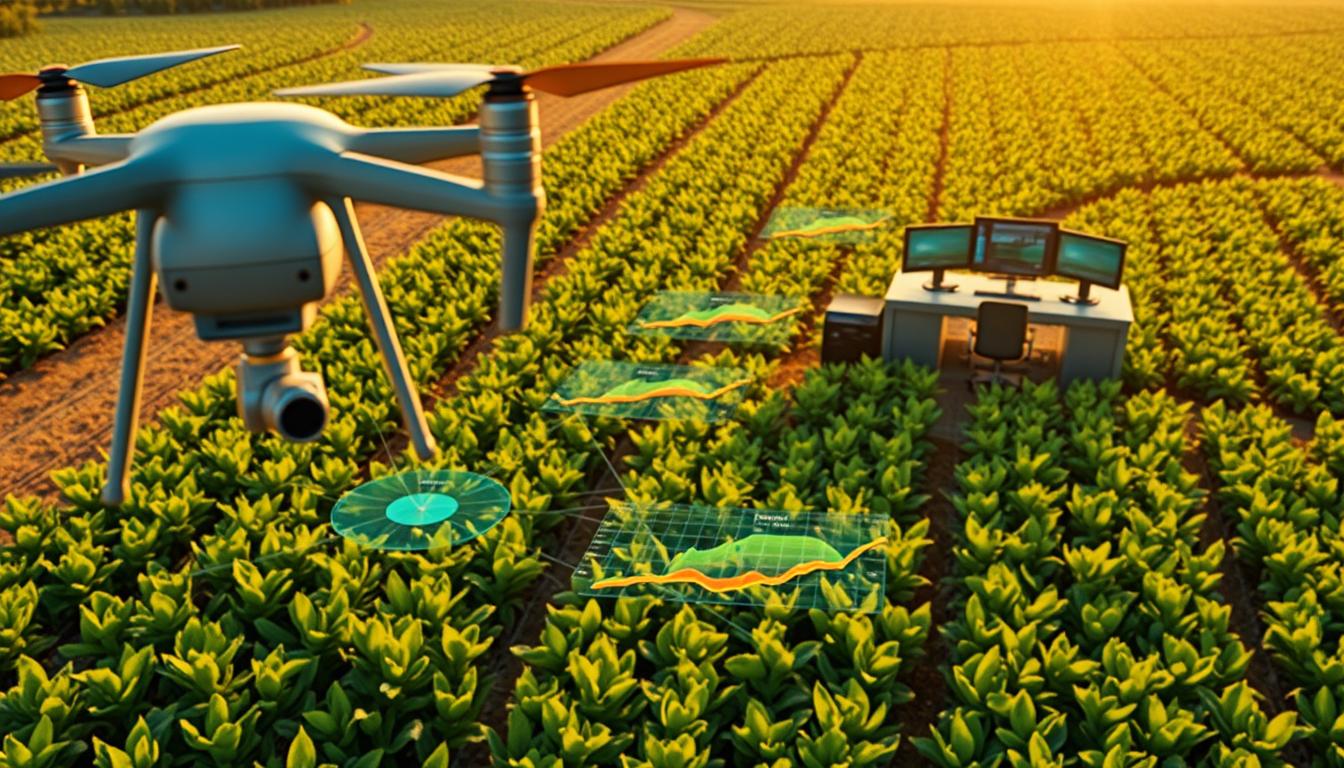
The farming world is changing fast. The market for drones in farming grew from $1.2 billion USD in 2019 to $4.8 billion by 2024. This big jump shows a big change in how we manage farms and get more from our land. Using drones can make crops grow up to 5% more, which is a big win for farmers.
So, what’s behind this change? Drone data analytics in agriculture uses drone pictures and special software to give us useful info about our fields. Drones with special sensors fly over our land. They collect data that shows how crops are doing, the soil, and how well water is being used.
In Australia, where farms are huge and the weather can change a lot, this tech is a game-changer. It turns drone pictures into useful info. Farmers can spot problems early, use resources better, and make choices that help their business and the environment. The global analytics market is expected to grow fast, showing drones are now a must-have for smart farming.
Key Takeaways
- The market for drones in farming is expected to grow from $1.2 billion to $4.8 billion by 2024, showing drones are becoming more common.
- Using drones can increase crop yields by up to 5%, which is a big win for farmers.
- This tech uses drone pictures and special sensors to show how crops are doing, the soil, and water use.
- Australian farmers can manage their big farms better, thanks to drones, especially in different weather zones.
- Drones turn pictures into useful info, helping farmers find problems early and use resources wisely.
- The global analytics market is expected to grow by 17.1% by 2028, showing drones are now a must for farming.
What Is Drone Data Analytics in Agriculture?
Drone data analytics is a big change in farming tech for Aussie growers. It uses drones to capture aerial data and process it for insights. This way, you get precise info on your crops and land, helping you make better choices.
Drone data analytics makes complex tech easy for farmers. You don’t need to be a tech expert to use it. It turns raw data into clear reports that show where you need to focus on your farm.
Definition and Core Principles
Drone data analytics in farming has three main parts. First, drones capture aerial data with special sensors. Then, algorithms turn this data into useful insights. Finally, easy-to-use platforms show you these insights in a way that helps your farming work.
Drone surveys start by flying over your fields. They take thousands of photos and data points. This data is geospatial data, linking each measurement to a spot on your land.
This method turns scattered data into detailed field maps. You can see how healthy your plants are, find drainage issues, spot pests early, and track growth. These maps can be edited to fit your needs, no matter the size of your farm.
The main idea of precision farming is to act on specific areas, not the whole field. Drone data helps you see where to focus, saving costs and reducing harm to the environment.
Evolution of Drone-Based Farming
Drone farming has come a long way from military use. Early drones were big, expensive, and hard to use. They were made for defence, not farming.
Big changes made drones useful for farming. Sensors got smaller, batteries lasted longer, and GPS got more accurate. This made drones better for farming.
Cloud-based systems made it easy to process drone data. You can upload data and get results quickly. This made drone tech available to all farmers, big or small.
Aussie farmers quickly adopted drone tech. It’s great for big farms in Australia. Early investments in tech helped make drones a natural fit.
| Era | Technology Characteristics | Agricultural Capability | Accessibility |
|---|---|---|---|
| Pre-2010 | Heavy, military-grade systems with basic cameras | Limited experimental use only | Extremely high cost, specialist operators required |
| 2010-2015 | Consumer drones emerge, improved sensors available | Early adopters test field monitoring applications | Moderate cost, technical knowledge needed |
| 2016-2020 | Purpose-built agricultural drones, multispectral sensors | Commercial services expand, yield monitoring capabilities | Decreasing costs, user-friendly software platforms |
| 2021-Present | AI-integrated systems, autonomous flight planning, extended range | Full-season monitoring, predictive analytics, integration with farm systems | Affordable for mid-size operations, service providers for smaller farms |
The Link Between Drones and Precision Agriculture
Precision agriculture is a big change from old farming ways. It uses drones to get detailed data for better farming. This approach is more accurate and efficient than before.
Before, farmers would walk their fields and guess what to do. Now, drones give a full view of your farm. This helps you make better decisions.
Drone data lets you apply treatments where needed. Your equipment can adjust on the fly based on drone data. This saves money and helps the environment.
Drone tech is good for the planet and your wallet. It cuts down on waste and saves you money. This is good for Aussie farmers.
Drone insights help you act early on problems. This can save your crops from damage. It’s a smart way to farm.
Common Terms and Concepts Explained
Drone tech for farming has its own language. Knowing these terms helps you talk to experts and choose the right tech. It makes farming easier.
UAVs and RPAVs are the same thing. UAV means Unmanned Aerial Vehicle, and RPAV means Remotely Piloted Aerial Vehicle. They’re used in farming, but RPAV is more accurate since a person controls it.
Geospatial data means data linked to a place. Every drone measurement has a location. This lets you make accurate maps and target specific areas for treatment.
Orthomosaics are big images made from many drone photos. They show your land in detail. You can measure things like distance and area from these images.
Multispectral imaging sees light that humans can’t. It shows plant health in ways regular photos can’t. Healthy plants reflect light differently than sick ones.
NDVI (Normalised Difference Vegetation Index) shows plant health. It compares light reflectance to find out how healthy plants are. This helps you see where your plants need help.
Autonomous flight planning lets you plan drone missions ahead. You set the area, altitude, and camera settings. The drone then flies the mission on its own, giving you consistent data.
These ideas are key to using drone data in farming. Learning about them makes using drones easier. It’s all about getting detailed data and using it to improve your farm.
How Drone Data Is Collected and Processed
Your drone is like a super smart data collector. It has special sensors that show things we can’t see. It turns simple pictures into useful crop info. This process is easy to understand, even if you’re not tech-savvy.
Drones do more than just take pictures. They gather detailed data on your land, like how healthy your crops are. This info helps you farm better by focusing on specific areas, not the whole field.

Data Capture Through Multispectral and RGB Sensors
Your drone might have RGB cameras or multispectral sensors. RGB cameras take pictures like your phone does. They’re good for making maps and counting plants.
Multispectral sensors are more powerful. They see light we can’t, like near-infrared. This lets them check how healthy plants are by looking at how they reflect light.
These sensors create special indexes like NDVI. NDVI shows how well plants are doing by comparing red and near-infrared light. Healthy plants show up as darker green on maps.
These sensors can spot problems early, like water issues or pests. Drones fly close to the ground, so they don’t get affected by clouds or bad light. They can even find tiny details that satellites can’t.
Image Stitching and Mapping Techniques
During a flight, your drone takes many photos. These photos are then put together to make detailed maps of your land. This is called photogrammetry.
Special algorithms look at the photos to figure out the land’s shape. They use math to find out where things are in 3D. This helps create detailed maps of your land.
These maps are very accurate. They show how healthy your plants are or where water might flow. You can make maps for different times to see how things change.
These maps can be made many times. This lets you see how your plants are doing over time. It helps you find problems and see if your fixes are working.
Cloud-Based Data Processing Workflows
Handling all those photos takes a lot of computer power. Cloud services solve this problem by doing the work on remote servers. You just upload your photos and get maps back quickly.
This way, you don’t need expensive computers or know a lot about tech. Cloud services make advanced farming tools available to everyone. They offer plans that fit your needs.
After you fly your drone, you upload the photos to the cloud. The cloud then makes maps and reports for you. This all happens fast, so you can make decisions quickly.
How long it takes to get your maps depends on a few things. But usually, it’s just a few hours. Some services can even do it in under an hour if you need it fast.
Real-Time vs. Post-Flight Analytics
Knowing when to use real-time or post-flight data is important. Each has its own uses. Many systems offer both, so you can choose what works best for you.
Real-time data lets you make decisions right away. It’s great for quick checks in the field. But, it might not be as detailed as post-flight data.
Post-flight data is more detailed and accurate. It’s better for detailed planning and keeping records. It uses more advanced tech that can’t be done while flying.
| Processing Type | Time to Results | Best Applications | Accuracy Level |
|---|---|---|---|
| Real-Time Analytics | During flight (immediate) | Emergency scouting, rapid problem detection, flight path adjustment | Good (85-90% of post-flight quality) |
| Post-Flight Processing | 2-6 hours after upload | Detailed mapping, record-keeping, treatment planning, yield forecasting | Excellent (millimetre-level positional accuracy) |
| Combined Approach | Immediate preview + detailed later | Comprehensive monitoring with quick field decisions and thorough follow-up | Real-time preview + full post-flight precision |
Autonomous farm data collection uses special software to plan drone flights. This ensures consistent data collection over time. By flying the same route, you can track changes in your crops.
This software plans the drone’s path based on the land and what you need to see. You only need to set the boundaries once. This way, every survey is done the same way, without human error.
Using drones and cloud services makes getting data easy. You can focus on using the data to improve your farm. This makes advanced tech accessible for everyday farming, not just research.
Why Drone Data Analytics Matters to Modern Farmers
Drone data analytics is more than just new tech. It brings real benefits that help your farm make more money and be more sustainable. It changes how you use resources, handle crop problems, and plan for the future.
It’s not just an extra cost. Smart farmers see it as a smart investment. It helps in many ways.
Farming today needs better ways to grow more and harm less. Old ways treat all areas the same, missing chances to do better. Drones show what each part of your field needs, making it possible to manage with precision.
Boosting Crop Yields Through Data Insights
Using drones can increase yields by up to 5%. This is a big deal in farming where profits are thin. For a big wheat farm, this could mean an extra $50,000 to $75,000 each season.
Drone tech finds problems early. It spots issues like nutrient gaps or pests before they get bad. This means you can fix things when it’s cheapest and most effective.
Drone data helps guess how much you’ll harvest better than ever. This info helps plan for harvest, storage, and selling. You won’t be surprised by low yields anymore.
Cost Savings Through Targeted Interventions
Drone checks are way cheaper than old methods. They cost less and give better views than planes or walking the fields. This saves money and time.
Drone data tells you what and how much to use for fertilisers and pesticides. This cuts down on waste and saves money. For example, using drones can save 15-30% on fertiliser costs, which is a lot for big farms.
Drone data helps decide where to put fertiliser. Healthy areas need less, and struggling ones get more. This avoids wasting money on healthy parts of the field.
Drone tech pays off in 1-2 years. It makes farming more productive and cheaper. Over time, you get even better at making decisions with the data you’ve collected.
Environmental Sustainability Benefits
Drone data helps use fertilisers better. This means less waste and healthier soil. It’s good for the planet and your farm.
Drone tech supports regenerative farming. It helps soil and ecosystems. It also cuts down on pollution in waterways, which is good for fish and plants.
Drone use also reduces greenhouse gases. Making fertiliser uses a lot of energy. Using less of it means less carbon dioxide in the air. Plus, drones help avoid harmful gases from the soil.
Drone data also saves water. It shows where to water and where not to. This saves water and money, and is better for the environment.
Enhancing Decision-Making and Forecasting
Drone data gives you solid facts instead of guesses. It covers every part of your land, not just a few spots. This means you catch problems early and avoid big losses.
Drone data helps predict harvests and yields. This helps plan for logistics and sales. Knowing when and how much to harvest means better planning and less stress.
Over time, drone data gets better at predicting yields. It learns from past data. This helps make better decisions about what to grow and when.
The table below shows how drones change farming:
| Management Aspect | Traditional Approach | Drone Analytics Approach | Quantified Benefit |
|---|---|---|---|
| Fertiliser Application | Uniform rate across entire field | Variable rate based on NDVI zones | 15-30% cost reduction |
| Pest Detection | Visual scouting of sample areas | Complete field thermal and multispectral scanning | Early intervention saves 10-20% crop loss |
| Irrigation Management | Schedule-based or general soil moisture | Zone-specific water stress mapping | 20-35% water usage reduction |
| Yield Forecasting | Historical averages and visual assessment | Mid-season biomass analysis and predictive modelling | ±5% accuracy vs. ±15-20% traditional |
| Field Assessment Frequency | Weekly or bi-weekly ground scouting | On-demand flights with same-day results | Respond to issues within 24-48 hours |
Drone data makes big decisions easier. It helps decide on new equipment, more land, or new crops. It shows what works best for your farm.
Drone data also makes managing risk easier. It lets you check on many places without needing to be there. This saves time and finds problems fast.
Using drone data with farm systems creates a centralised intelligence platform. It combines all important farm info. This helps make better decisions for the whole farm, not just parts of it.
Who Uses Drone Data Analytics in Agriculture?
Drone data analytics has created a thriving community of users. They use the technology for different agricultural purposes. This includes everything from small farmers to big companies.
Australia’s big farms and high labour costs make drones very useful. They help with many tasks in farming, research, and services.
Farmers and Agronomists
Farmers are the main users of drone technology. But, how they use it depends on the size of their farm. Large-scale commercial operations often have their own drone teams. They fly drones regularly to make decisions based on aerial data.
Small to medium family farms usually get drone services during important growth stages. This way, they can try out drones without buying them. It’s great for testing before deciding to buy.
Agronomists use drone data to give advice. They check how well treatments work, document crop conditions, and follow rules. Your agronomist’s skill in using aerial data is key to getting value from technology.
Japan was one of the first countries to use drones in farming, especially for spraying. South Korea uses drones for about 30% of their spraying.
Agricultural Service Providers
A new group of service providers offers drone services. They help make drone technology easy to use for farmers. In Australia, you can find different types of services:
- Full-service providers do everything from flying to giving reports
- Data collection specialists capture images and give you files
- Interpretation consultants help you understand the data and make decisions
- Equipment rental services let you use drones yourself
These services let you use drone data without owning drones. It’s great for Australian farmers who want to try drones before buying.
Many contractors now offer drone services. Your local spraying contractor might also do crop monitoring. This makes it easy to get all your services from one place.
Research Institutions and Governments
Universities and places like CSIRO use drones for research. They test new crops, develop algorithms, and improve technology. By joining research, you get access to new tech before it’s widely available.
Government departments use drones for many things. They check crop conditions, watch for pests, and follow environmental rules. The US, China, and South America are investing a lot in drone technology for farming.
State departments also use drones in emergencies. They check damage from floods, droughts, and bushfires. Drone technology is useful for more than just farming.
| User Type | Primary Application | Technology Access Model | Data Usage Frequency |
|---|---|---|---|
| Large-Scale Farmers | Crop monitoring and yield optimisation | In-house drone programs | Weekly to fortnightly |
| Small Family Farms | Critical growth stage assessment | Contracted services | Seasonal (3-5 times annually) |
| Service Providers | Data collection for multiple clients | Commercial drone fleets | Daily operations |
| Research Institutions | Agronomic trials and algorithm development | Specialised research equipment | Project-based schedules |
| Government Agencies | Compliance and biosecurity surveillance | Department-owned fleets | Monthly to quarterly |
Agri-Tech Startups and Innovators
Agri-tech startups are creating new tools and platforms. They combine drone data with other data like weather and soil sensors. This creates a complete system for managing farms.
Australian startups are making tools for our unique farming needs. They tackle big challenges like big farms, changing weather, and different soils. Current drones work best with common crops, but they’re working on recognising other crops too.
International companies are coming to Australia to serve our market. This means you get the latest tech and help shape the future of farming.
Startups often offer free trials or basic versions. This lets you try different tools before choosing the best one. Your feedback helps improve the tools for farming.
What Types of Data Do Drones Collect on Farms?
Agricultural drones are like flying labs. They capture precise data to help you make smart decisions. They collect many types of information at once, turning raw data into useful insights.
These drones do more than just take pictures. They gather data on everything from plant health to soil quality. By combining this data, you can spot patterns that are hard to see from the ground.
Vegetation Index Analysis and Plant Vigour Assessment
The Normalized Difference Vegetation Index (NDVI) is a key tool for farmers. NDVI uses colour to show plant health. Healthy plants reflect near-infrared light, while absorbing red light for photosynthesis.
Drone cameras turn these light patterns into maps. Green areas show healthy growth, while yellow and red spots indicate problems. This makes complex data easy to understand.
Tracking NDVI over time helps you see how crops are growing. This lets you spot any issues early. You can then fix problems like nutrient shortages or pests before they get worse.
Multispectral sensors can spot plant stress up to 10 days early. This gives you time to act before damage is obvious. Early action can save money and be more effective.
Understanding Soil Conditions From Above
Soil moisture mapping changes how you water your crops. Thermal imaging shows where the soil is wet or dry. This helps you fix uneven watering.
Advanced drones use microwave sensing to measure soil moisture. This method works even when crops are dense. Using drones for soil moisture can cut water use by 20-30%.
Some drones can even check soil nitrogen levels. They create maps to show where you need to add fertiliser. This helps you use fertiliser more efficiently.
Early Warning Systems for Agricultural Threats
Drone surveillance can spot pests and diseases early. They can see changes in plant colour or texture that indicate problems. Acting fast can save your crops.
In Australia, drones help manage threats like locusts and fungal diseases. They identify affected areas for targeted treatments. This saves time and money compared to treating the whole field.
Drone surveillance is especially useful for large farms. A short flight can cover a lot of ground. This lets you check on your farm more efficiently.
Terrain Intelligence for Water Management
Drone mapping creates detailed models of your land. These models show how water moves. Knowing your land’s shape is key to managing water.
These maps help you find and fix water problems. They show where water collects or where it’s needed. This leads to better watering practices.
Using these maps helps with many farm tasks. They guide drainage system design and irrigation planning. You can invest in your farm with confidence.
Combining different data types gives you a full picture of your field. This helps you understand why some areas don’t do well. Maybe a low spot collects water, or a high spot dries out too fast.
With this knowledge, you can make targeted improvements. This can turn problem areas into productive land. Your drone data helps you improve your farm every season.
Where Drone Data Analytics Is Making the Biggest Impact
Drone analytics shines in certain farming areas, bringing big improvements. The success of drones depends on the crop, farm size, and local setup. Knowing where drones work best helps you spot chances in your farm.
Drone use is most valuable in crops where small changes make a big difference. Farms in hard-to-reach places also see big benefits. Drone use patterns show clear winners in different farming areas and regions.
Vineyards and Specialty Crops
Australian wineries are big users of UAV farm surveillance. They invest in drones to watch over their vines. This helps manage vine health and cut costs.
Drone data makes irrigation precise. Water stress shows up before you see it, helping adjust water use. This keeps berries growing well.
Drone maps help pick the best fruit first. This means better quality grapes for wine. It’s a big win for winemakers.

Drone tech also helps with almonds, avocados, and veggies. It checks on each tree or plant. This gives buyers proof of how crops were grown.
Large-Scale Grain Farming
Drone tech changes the game for big grain farms in Australia. It’s hard to check on huge areas by foot. Drones do it fast and cover everything.
Drone data shows how each part of the farm is doing. This lets you manage better. It’s a big improvement over old ways.
Drone data helps target where to use fertiliser and weed killers. This saves money and keeps weeds down. It’s a smart way to farm.
Drone data helps plan for the long term. It finds problem spots that need fixing. This leads to better farming for years to come.
| Agricultural Sector | Primary Benefit | Typical ROI Timeline | Australian Adoption Rate |
|---|---|---|---|
| Wine Grapes | Quality optimisation through precision irrigation and selective harvest | 1-2 seasons | High (established regions) |
| Broadacre Grains | Comprehensive monitoring of large properties enabling zone management | 2-3 seasons | Moderate to High |
| Tree Crops | Individual plant health monitoring and targeted treatments | 2-4 seasons | Moderate (growing rapidly) |
| Vegetables | Quality documentation and rapid problem detection | 1 season | Moderate (intensive operations) |
Greenhouse and Urban Agriculture
Drone tech is changing greenhouses and urban farms. It’s great for places that are hard to reach. It helps without disturbing plants.
Indoor farms use drones to watch temperature. This stops damage before it starts. It’s a smart way to keep crops healthy.
Drone tech is key for urban farms. It’s perfect for places with little space. Drone surveillance covers everything without getting in the way.
Drone sprayers and security drones are also useful. They reach places that are hard to get to. This saves time and keeps crops safe.
Regions Leading in Drone Agriculture
Japan was the first to use drones in farming. They use them for spraying and checking on crops in tough places. Japanese companies made the first drones for farming years ago.
The US is leading in using drones for big farms. They use drones to check on fields and plan better. They focus on making drones work with existing farm systems.
China is the biggest market for drones in farming. The government is investing a lot. Chinese drones are affordable, making them available to more farmers.
Australia combines ideas from other countries and adds its own twist. It’s good for farms in dry areas and big properties. Drones make checking on farms fast and easy.
Australia has chances to innovate in tropical farming and checking on drought. The high cost of labour and big farms make drones a good choice. They help in many different types of farming.
When to Use Drone Data Analytics During the Crop Cycle
Timing your drone flights right is key to getting useful insights. Instead of flying randomly, successful precision farming matches data collection with key crop cycle moments. This way, you get insights that help make better decisions.
Knowing when to use drone field surveillance makes your farm management proactive. Here are some timing tips to help you get the most from every flight. This way, you avoid flying too much and getting little useful information.
Soil Analysis Before Crop Establishment
Soil surveys before planting help choose the right variety and prepare the soil. These flights show soil variations that affect crop growth later. They reveal differences that hide once crops grow.
Elevation mapping finds areas where water pools after rain. This info helps improve drainage or choose the right plants for those spots. It also helps decide how deep to till the soil.
Soil images show texture differences that affect moisture and nutrients. This lets you adjust how many seeds you plant in different areas. It’s a smart way to use your seeds.
Weed mapping early on shows where weeds are most common. This lets you apply weed killers where needed most. It also helps plan when to cultivate to control weeds.
These early surveys change how you prepare the land. Instead of treating every area the same, you manage each part differently. This helps crops grow better from the start.
Ongoing Crop Health Assessment
Checking crop health mid-season is very valuable. Your schedule should match the crop’s growth and risks. This way, you get the most useful information.
Weekly drone field surveillance is best during critical growth times. This includes when cereals tiller, canola flowers, or potatoes form tubers. These times are crucial for yield.
Regular checks show how crops are growing over time. Images taken weekly or every two weeks show changes in plant health. This helps spot problems early.
Surveillance after planting finds gaps in the crop. You can replant in these spots before it’s too late. It also finds disease or pests before they spread.
How often you fly drones mid-season depends on the value of the information. At first, you might fly more often. But as you learn, you can focus on the most important areas.
Forecasting Harvest Volumes
Before harvest, drones help estimate how much you’ll get. This info improves planning and selling. It’s a big win for your farm.
Drone data uses advanced math to predict yields. It looks at how green the plants are and how much biomass they have. This gets more accurate over time.
Knowing how much you’ll harvest helps plan everything. It’s better for storing grain and selling it. This way, you make more money from your harvest.
Drone data also lets you sell grain before you harvest. This means you can get better prices without worrying about how much you’ll have. It’s a smart way to make more money.
The best time to fly drones before harvest is 3-4 weeks early. This captures the most important information about your crop.
End-of-Season Field Documentation
After harvest, drones help assess the land. This info is key for planning next season. It also helps protect your interests with detailed records.
Drone images show how evenly stubble was spread. Uneven stubble affects germination and disease. This info helps manage stubble better.
Soil exposure patterns show where erosion is likely. These areas need extra protection. Knowing this early helps prevent damage before winter.
Images after harvest show where weeds might grow. This helps manage weeds before planting again. It’s a smart way to control weeds.
Drone images after harvest also help with insurance claims. They provide clear evidence of field conditions. This makes it easier to get help if needed.
| Crop Cycle Phase | Optimal Flight Frequency | Primary Data Captured | Key Management Decisions |
|---|---|---|---|
| Pre-Planting | Once per season | Soil texture, elevation, weed pressure | Variety selection, variable seeding rates, drainage planning |
| Early Season | Fortnightly | Emergence uniformity, stand gaps | Targeted replanting, early weed control |
| Critical Growth Stages | Weekly | Crop health indices, stress detection | Irrigation scheduling, pest intervention, nutrient application |
| Pre-Harvest | Once (3-4 weeks before) | Canopy measurements, biomass estimates | Yield forecasting, harvest logistics, forward selling |
| Post-Harvest | Once per season | Residue distribution, soil exposure, volunteers | Stubble management, erosion control, rotation planning |
Your drone strategy will change as you learn more about your farm. Start with detailed surveys to find the most valuable times. Then, focus on those areas for the best results. This way, your precision farming keeps getting better.
Comparing Drone Data Analytics vs. Satellite Imagery
Farmers have to choose between drones and satellite imagery for crop monitoring. Both offer valuable data but differ in many ways. Knowing these differences helps pick the right tool for your farm.
In Australia, many farmers use satellite data to check on their crops. But, drones have become more affordable, offering detailed monitoring. It’s not about which is better, but when and how to use them together.
Resolution and Data Frequency Differences
Satellite imagery has 3 to 10 metre pixel resolution. Drones can get as close as 1 to 5 centimetre resolution. This means drones can see individual plants, while satellites see many rows at once.
This difference lets drones spot small problems that satellites miss. You can see disease, pests, or equipment issues in small areas. Satellites are better for looking at the big picture, but drones are better for details.
Satellites update data every 3 to 7 days. But, Australian weather often blocks this, leaving gaps of weeks. This is a big problem during growing seasons.
With drones, you can fly whenever you want. This means you can get data when it’s most important, without weather getting in the way.
Cost and Accessibility Factors
Cost is a big factor in choosing between drones and satellites. Satellite services cost $2 to $5 per hectare annually. This is good for big farms.
Drone costs include equipment, flying time, and processing. These add up to $5 to $15 per hectare. For farms doing 3 to 4 surveys a year, drones can be cheaper and better.
Satellites need subscriptions and can be slow. Weather can also block data. Drones are faster and more flexible.
Drones are easy to use. You fly when you want and get data quickly. This lets you make fast decisions that satellites can’t.
| Factor | Satellite Imagery | Drone Technology |
|---|---|---|
| Pixel Resolution | 3-10 metres | 1-5 centimetres |
| Data Frequency | 3-7 days (weather dependent) | On-demand (user controlled) |
| Cost Per Hectare | $2-$5 annually | $5-$15 per survey |
| Coverage Area | Unlimited (regional scale) | Limited by battery (farm scale) |
| Weather Impact | High (cloud cover issues) | Low (fly below clouds) |
Integration With On-Farm Systems
Satellites and drones both work with farm management software. They provide data like images and maps that help manage farms.
Drones make workflows easier. You can go from flying to making plans without waiting for data. This saves time and makes decisions faster.
Farms can use both satellites and drones. This lets you get the best of both worlds. You’re not stuck with just one option.
Software is getting better at combining data from both. This means you can see both the big picture and the small details. It’s a powerful way to manage your farm.
Case Studies Showing Combined Use
Many Australian farmers use both drones and satellites. Satellites watch the whole farm, and drones check specific areas. This way, they get the best of both worlds.
When satellites find a problem, drones go in for a closer look. This way, you get the big view and the small details. It’s a smart way to use resources.
A grain farm in Western Australia uses this method. Satellites check the whole farm, and drones look at specific areas. This helps them find and fix problems fast.
Vineyard managers do the same thing. They use satellites for the big picture and drones for details. This helps them make the best decisions for their vineyards.
You don’t have to choose between drones and satellites. You can use them both to get the best data for your farm. This way, you can make smart decisions based on the best information.
The Role of AI and Machine Learning in Drone Analytics
Machine learning is changing drone analytics. It turns drones into systems that give insights without needing humans all the time. This change helps you get more value from aerial images, making analysis faster.
Drone technology gets better with AI. It becomes smarter and more accurate over time. This makes farm data intelligence stronger.
Your drone works better with AI. It can spot patterns, predict things, and find oddities in many images. These systems get better with each flight, handling different farming situations.
Automated Object Recognition
Crop analytics software now finds individual plants and weeds. It does this quickly and accurately. This technology can spot pests and diseases early, helping your crops.
To work well, these systems need lots of labelled images. They learn to see small changes in plants. As they get more data, they get better at spotting problems.
Modern recognition systems handle complex tasks including:
- Counting plants in big areas
- Finding weeds for targeted spraying
- Helping machines move through fields
- Spotting pests for quick action
- Finding diseases early
But AI has its limits. It works best with common crops in big fields. It needs more training for different crops and growing conditions.
Predictive Analytics for Crop Performance
Machine learning predicts crop yields weeks before harvest. It looks at past data, weather, soil, and farming practices. This helps you make decisions and plan better.
AI can also predict diseases. It looks at how crops grow, moisture, and weather. This lets you treat problems before they start, saving crops and reducing chemicals.
Predictive modelling delivers actionable forecasts for:
- Yield estimation for planning
- Disease risk for early treatment
- Irrigation needs based on crop stress
- Best time to harvest for quality
- Nutrient needs for healthy crops
These predictions help you manage better. You can solve problems before they hurt your crops. This keeps your yields and quality high.
Real-Time Anomaly Detection
Drone systems now spot problems as they fly. They can find issues like broken equipment or pests quickly. This makes your drone a smart scout.
These systems compare new images to old ones. They find big changes that need attention. This means you can fix problems fast, saving your crops.
This quick feedback is key during important growth times. It helps protect your crops. Researchers are working on drones that can keep monitoring without needing people.
Machine Learning for Data Calibration
Drone data needs adjusting for things like sun and weather. Machine learning does this automatically. It keeps your data consistent, no matter the season or equipment.
Calibration algorithms use reference data to improve accuracy. They learn from mistakes, making your measurements better. This saves time and keeps your data reliable.
Algorithmic calibration addresses technical challenges including:
- Changes in sun angle affecting readings
- Weather affecting spectral data
- Sensor wear and tear
- Differences between drones
- Changes in crop background
Future drones might work together, sharing data. This will create a complete picture of your farm. It will help you make better decisions.
Improving AI is key for smaller farmers. It needs more training for different crops and complex situations. But, the future looks bright for drones in farming.
Tools and Platforms for Agricultural Drone Data Analysis
Choosing the right crop analytics software is key. It turns drone footage into useful farm data. The platform you pick affects how fast you can use these insights in your daily work.
Leading Software Solutions for Drone Agriculture
DroneDeploy is a top choice for its easy use. It uses cloud-based workflows to process aerial images. You can plan flights, upload data, and get analysis without needing expensive computers.
Pix4D gives farmers advanced tools for specific needs. DJI teamed up with PrecisionHawk for affordable solutions. They offer drones and DataMapper software. This includes tools for checking water and nitrogen levels, plant health, and counting plants.
Specialised Agricultural Solutions
Sentera offers complete packages for crop monitoring. Agrisoft Metashape gives users full control over image processing.
Connecting With Your Existing Farm Systems
Today’s tech lets you link with Ag Leader, Trimble, and John Deere. This makes sharing prescription maps easy.
Budget-Friendly Processing Options
OpenDroneMap and QGIS with drone plugins are open-source. They’re free but need technical skills. They work well in Australia’s rural areas because they process on your computer.
FAQ
What exactly is drone data analytics in agriculture and how does it differ from simply flying a drone over my paddocks?
Drone data analytics in agriculture is more than just flying a drone. It involves collecting aerial images with special sensors. Then, it uses advanced algorithms to turn this data into useful information about your crops and soil.
While flying a drone gives you visual footage, drone data analytics goes deeper. It uses sensors that see beyond what we can see. It also stitches together hundreds of photos into detailed maps. These maps show how healthy your plants are and where you might need to make changes.
This process transforms raw footage into valuable insights. It’s what sets professional drone use apart from just flying for fun. It helps farmers make better decisions and improve their yields and profits.
How accurate are drone-generated crop health maps compared to traditional scouting methods?
Drone-generated crop health maps are very accurate. They can spot plant stress up to 2 weeks before it’s visible to the naked eye. This is because drones capture detailed measurements across your entire field.
Traditional scouting only looks at a small part of the field. It relies on what you can see. But drones give you a complete picture, helping you find problems early and solve them quickly.
What’s the difference between RGB cameras and multispectral sensors on agricultural drones?
RGB cameras capture images like your smartphone does. They show what you can see with your eyes. But multispectral sensors see beyond what we can see.
They capture near-infrared light, which healthy plants reflect. This lets drones calculate how well plants are doing. RGB cameras cost less but multispectral sensors are more expensive. They’re worth it for the detailed insights they provide.
How much does it cost to implement drone data analytics on my farm?
The cost varies depending on whether you buy or rent a drone. Buying a drone with multispectral sensors can cost between ,000 and ,000. You’ll also need to pay for software and training.
For smaller farms, renting a drone might be cheaper. It costs around to per hectare per flight. This way, you can try out drone technology without a big upfront cost.
Can I fly my drone and collect farm data whenever I want, or are there legal restrictions?
There are rules for flying drones in Australia. If you’re flying for fun, you might not need a license. But if you’re flying for work or with a bigger drone, you’ll need a special license.
You must always keep the drone in sight. You can’t fly over people unless you have permission. And you can’t fly near airports without special permission.
How long does it take to survey a typical Australian farm with a drone?
The time it takes depends on the size of your farm and the drone’s capabilities. A 500-hectare farm might take 3 to 5 hours to survey. This includes setting up, flying, and changing batteries.
For bigger farms, it might take longer. But modern drones can plan their flights automatically. This makes the process faster and more efficient.
What internet connectivity do I need for drone data analytics on my rural property?
You don’t need internet to fly the drone. But you do need it to process the data. Cloud-based services like DroneDeploy need fast internet to work well.
But there are solutions for areas with slow internet. You can process data locally or use mobile hotspots. This way, you can still use drone technology even with limited internet.
How do I transform drone-generated maps into actual management actions on my farm?
To use drone data, you need to understand what it means. You can use the maps to find problem areas. Then, you can treat those areas specifically.
You can also use the data to make decisions about how much fertilizer to use. This way, you can save money and improve your yields. It’s all about using the data to make smart choices.
Can drone data analytics predict my crop yield before harvest?
Yes, drone data can predict yields with good accuracy. It looks at things like how green the plants are and how tall they are. This helps farmers plan better.
It’s especially useful for crops like wheat and barley. But it’s not as good for crops like potatoes. Still, it’s a valuable tool for making informed decisions.
What’s the learning curve for operating drone data analytics systems?
Learning to use drone data analytics takes time. It involves basic drone flying skills and understanding the data. But the biggest challenge is interpreting the data.
It takes practice to understand what the data means. But with time, you’ll get better. It’s all about learning to make decisions based on the data.
How do I ensure data privacy and security with cloud-based drone analytics platforms?
To keep your data safe, choose a reputable platform. Look for encryption and secure servers. Also, make sure you can control who sees your data.
Some platforms offer more control than others. You might need to use a desktop solution if you’re really concerned about privacy. It’s all about finding a balance between convenience and security.
What’s the expected lifespan of agricultural drone equipment, and when should I consider upgrading?
Drones typically last 3 to 5 years before they need to be replaced. The airframe can last longer, but the sensors and cameras get outdated faster.
It’s important to keep up with technology. Upgrading can help you get better insights and stay competitive. But it’s also about finding the right balance between cost and value.
Can I use my consumer drone for farm data collection instead of buying expensive agricultural drones?
Consumer drones can be a good starting point. They’re cheaper than agricultural drones and can capture basic images. But they have limitations.
They don’t have the advanced sensors needed for detailed analysis. But they can still be useful for certain tasks. It’s all about finding the right tool for the job.